


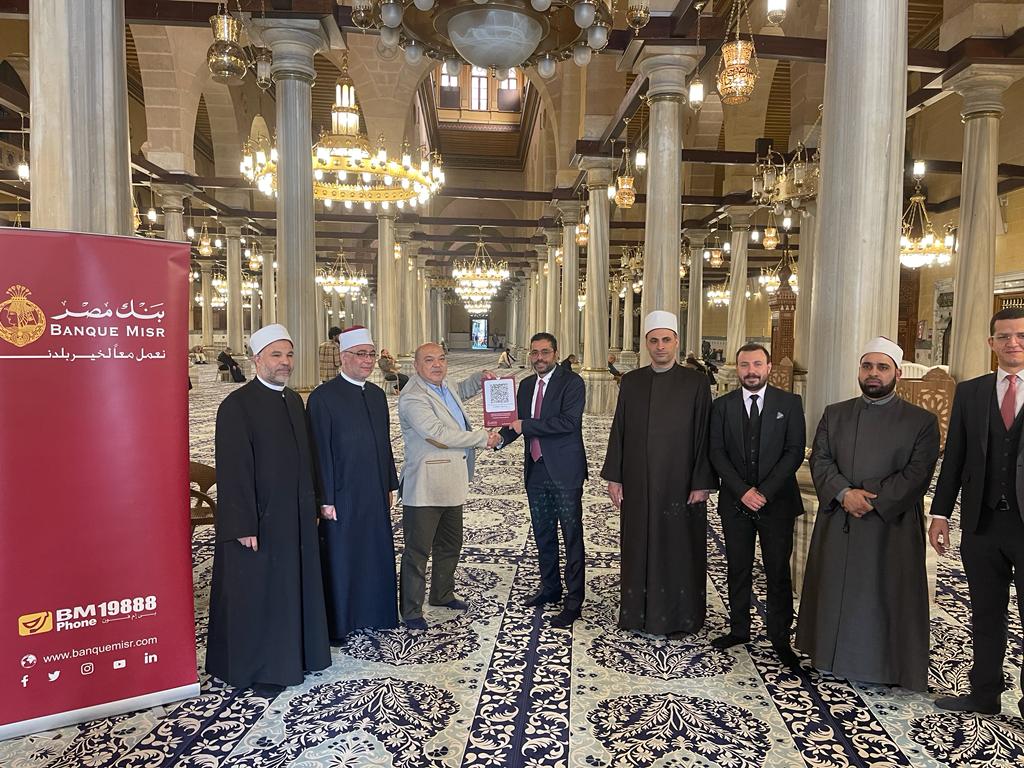
For the first time in Egypt Banque Misr is starting to deliver the QR Code to major mosques in Egypt to allow online donations using such QR Code in order to activate the Collaboration Protocol between Banque Misr and mosques affiliated with the Ministry of Awqaf, for automating Zakat and Donation Boxes in mosques and electronic collection of the same.
Within the framework of Banque Misr’s implementation of the collaboration protocol concluded with mosques affiliated with the Ministry of Awqaf to automate zakat and donations boxes in mosques and collect the same electronically, the QR Code for a number of major mosques in the Arab Republic of Egypt, including, for example; Imam Hussein Mosque as the first mosque in which donations are made available via the QR Code, in the presence of Mr. Ihab Dorra – Head of Branches and Retail Banking Sector at Banque Misr, Eng. Samir Al-Shall - Permanent Undersecretary at the Ministry of Awqaf, Sheikh / Sabri Yassin - Head of the Central Administration for Inspection and Control, Dr. Hisham Abdel Aziz - Head of the Religious Sector at the Ministry of Awqaf, and Dr. Khaled Saleh - Undersecretary of the Ministry of Awqaf in Cairo. It is worth noting that the number of mosques in Egypt reaches about 160 thousand mosques nationwide, and the QR Code for the rest of the mosques will be delivered successively.
This protocol is within the framework of Banque Misr’s keenness to provide a secure electronic collection tool, which enables citizens who wish to donate or pay zakat money, by providing POS machines using bank cards. Subject to this Protocol, QR Codes are distributed to each mosque, so that donations can be made through electronic wallets, in all mosques affiliated with the Ministry throughout Egypt, in which the service will be provided, in addition to cooperating with Fawry Dahab Company to provide payment service through the identification code of the mosque, through the Fawry network spread in all governorates in Egypt.
Banque Misr adopts the concept of digital transformation and innovation, and seeks to localize advanced technological services in its various dealings in order to facilitate the payment process for the Egyptian citizen, in line with the policies of the National Council for Electronic Payments, by working to stimulate the use of electronic means and channels for payment instead of using cash. This protocol aims to automate zakat and donations boxes in mosques, in light of the issuance of a decision banning the collection of donations, cash aid or setting up boxes for donations in mosques; which was issued in line with the state’s directions in achieving financial transparency, organizing in-kind and cash donations, increasing and supporting non-cash payments, and developing a governing and organized framework for all financial dealings in order to preserve such funds and ensure their proper access to their various banks.
Banque Misr supports digital transformation efforts by providing electronic solutions to facilitate customers, thereby further contribution to provide banking and financial services in an easy and advanced manner. Banque Misr also works to enhance its success and participate effectively in providing services and entering into initiatives and protocols that meet the needs of all customer segments, as the bank's business values and strategies always reflect its commitment to sustainable development and prosperity for Egypt.
